Wednesday, August 15, 2018

July was Silver


July was silver, and August gold
The summer I realized I was old;
Deep were the shadows, full the pear,
Heavy the dewdrops, drowsy the air.

Autumn was cloudy, but the sky was high
The winter I knew I was going to die;
Long were the hours, and short the years,
Sweet the forgetting, and salt the tears.


Friday, February 22, 2013

News

These days, I'm more active here.

Thursday, June 10, 2010

My German Teacher

T Jones' comments on Pandorina morum reminded me of a piece I wrote several years ago about one of my high school teachers. Here it is:

My German Teacher

"Whatsoever thy hand is able to do, do it earnestly." (Ecclesiastes 9:10)

We worked hard in my high school German class. Our instructor was Father Richard Cleary, an Oblate of St. Francis de Sales and an unusually effective teacher. I still marvel at how he got forty 15-year-olds to sit through it all: conversational drills, reading exercises, and homework every night.  Fr. Cleary's little discourses on German life and culture we counted as small respite. Yet he was able to get even the most rambunctious students to cooperate.  In the three years I had him as a teacher, I saw him give detention exactly once, and it broke his heart to do so.  He gave us his best, and we felt we could do nothing less in return.  His encouraging smile even got us very cool adolescent boys to sing "O Tannenbaum" and "Stille Nacht" every Christmas.

Not long ago I met up with Fr. Cleary again, more than twenty years later. [Note: Fr. Cleary has since died, in 2009.] He's working in an inner-city parish, gracious as ever.  I brought him a bottle of Eiswein, the special wine of the Rhine region made from grapes frozen on the vine.  We talked about his teaching days.  I asked him if he had kept his knowledge of German sharp.  Had he a flair for languages?  Had he lived or traveled in Europe, perhaps?  "Oh, that," he smiled.  "When I reported to the high school, they said they needed a German teacher. I had had some German in college, so I got the textbook out and started studying.  I managed to stay a couple of chapters ahead of you guys."  He had, in fact, spent most of his priestly career as a spiritual director.

Did I feel cheated that my beloved teacher was not a German scholar?  Far from it!  He had impressed many things on my young mind:  the necessity of order, of patient effort, of respect for others.  To work hard and joyfully at what needs to be done-- I can't think of a better expression of the message of Christ.  And I wish I had more of Fr. Cleary's spirit of service, without which the word of God would wither and die among men.  I learned all that, and-- oh, yes, a lot of German, too.


Tuesday, June 8, 2010

"All Writing is Curious"

This blog started out as little more than a diary, but I didn't want it to be my mental meanderings only. I had to include something of the outer world, something that, yes, an audience, can relate to. I hope what I fling out there lands somewhere between introspection and pontification.

Anyway, today I ran across a pellucid essay by the poet Dudley Fitts. It's extensively quoted by David R. Slavitt in Re Verse: Essays on Poetry and Poets. Fitts says he writes for an imaginary audience that is "concerned, sympathetic, cultivated in [its] tastes, demanding but forgiving, witty, well read and above all a fan." This imagined audience is, in fact, his imaginary friend from childhood! I've never thought that way before, but I think he's perfectly correct. It's odd, I think, but true. But, as Fitts say, "all writing is curious."

Friday, May 21, 2010

Pandorina morum


Were we not talking about microorganisms? I ran across this this morning and had to put it up, if only to accompany the painting in the last post. This is a microorganism, not abstract art, as drawn by Sister Catherine Francis Regli in her master's thesis from 1941. Drawn right into her typed thesis, in pen and ink. No place for timidity or sweaty palms. And there are 53 such illustrations, drawn with the same delicacy and precision.

Makes me think of illuminated manuscripts. Makes me think of...a lot of things. I was talking to a biology professor recently and he stated how incredibly hard it is to get students today to look into a microscope and draw--even crudely--what they are seeing. Aside from lacking all patience to do such a thing, they just don't "see," he said.

I was rather a science geek in school. Catholic kids back then saw science as a grand adventure, a peek into the mind of God. I think science requires an inherent belief in reason, order, benevolence, and a Creator. A background, if you will, for seeing. "Let there be light."

Some years ago, when I was drifting away from the Buddhist fold, after years of seeing everything as appearance, as untrustworthy, where one idea is as bootless as the next-- I took a course in Aquinas. The professor tossed out one day, almost offhandedly, "Oh, yes, the principle of identity: a thing is what it is." I felt like I had been plunged into a refreshing bath of cold water. A thing is what it is! Of course! If, that is, you believe in things, and your ability to comprehend them. If you believe the world is reasonable. If you believe...

Sister Catherine Francis, if she got her master's in 1941, was probably teaching when I was attending school. Men and women like her led me to the same fountains of faith from which she had imbibed.

Saturday, April 24, 2010

More on the Trinity


Many artists are inarticulate, really. Emotionally raw. They can't explain very well what they do. They just do it, albeit sometimes magnificently.

We have a little revolving art gallery here, so I read a fair number of artists' statements. Most tend to be vague, vapid, or sententious. Some have only the most tenuous of connections to the objects on the wall, making the reader/viewer feel stupid for "not getting it." Some are so bizarre one fears for the poor fellow's sanity.

The artist's statement here at the current exhibit is perfectly balanced, I think, between specificity and abstraction, intellect and emotion. It actually helped me in looking at the paintings!

I'll let the artist, Vincent McLoughlin, tell you what he does in his own words: "The panels...deal with three. Red. Yellow. Blue. Applied opaquely, translucently, and transparently in layers of three." Then he starts to intrigue me: the three colors make him think of Father, Son, and Holy Spirit; Plato's three-fold division of human psychology, the appetitive, the spirited, the rational; Darwin (variation, heredity, struggle for existence), Lincoln (government of, by, and for the people). A structured analysis, yet opening out to endless possibilities.

I found the paintings to look like kaleidoscope images. Crystals. No wait, they look like growing microorganisms. And look, there's an evolving eye! No, wait-- a city, a parliament, a cluster of berries! Love, growth, communion! And I liked thinking of the Trinity as the origin of it all.

In spite of the old adage to view from the distance, I found the paintings were even more intriguing close-up, once I understood the artist's technique.

Sometimes the artist is his own best critic. Certainly he should be his own best advocate.

Friday, April 16, 2010

Artifacts


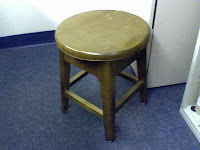
This a stool in steady use here at the college. Sturdy and serviceable. I turned it over today and saw this:

I don't know if you can read that, but it says "1966." Forty-four years, an impressive record of service. You can look at the old college catalogs around here and see that the tables and chairs in the photos are still in use today.

Some people like that, admiring human-made articles that last and last. Richard Wilbur wrote a poem to that effect, and decried the gimcrackery of so much modern manufacture. (I just ran across it the other day; sorry, I can't remember where. But once I heard him read it!-- that was a fine afternoon.) I'm more an Ozymandias man myself. Not much of our stuff lasts.

I have an indelible image in my mind, from a newscast during the Yugoslav wars. It is of a Soviet-era tank blasting holes in the facade of a 50's or 60's style apartment building. A modern building, with clean, low lines and spare ornament. Above all, a modern building! For me, such architecture encapsulated all sorts of romantic notions about the twentieth-century world. Universal peace, world cultural exchange, scientific advancement, sophisticated art-- all just over the horizon. Jet planes, dams, reactors, rockets, the monorail--and those apartment buildings--all artifacts of a grand new civilization. And now they were being blown up!

"The end of history," they said. No, actually the beginning, or the re-beginning. "What rough beast slouches toward Bethlehem to be born?"

None of our stuff will last.

Monday, April 12, 2010

Hail to the Guru

What with Easter and all, I forgot to mark the anniversary of the passing of Trungpa Rinpoche. April 4 was the day. I rested under the white umbrella of his buddha-activity for many years. Chokyi Gyatso, the Eleventh Trungpa-- hail to the guru! Hail to the root guru!

He once said, "This is the great odyssey I have never feared." He was speaking of bringing Buddhism to the West, but the line was used at his funeral, appropriately. It was never really true for me, till now, with Dad's passing. The last two months have been bracing, yet comforting in a larger sense. Welcome, Sister Death, St. Francis said. Each of us must make his peace with death. As one gets older one is privileged to see, and quite often too, ordinary people exhibiting wisdom and heroism, grace and peace at their end.

Saturday, April 3, 2010

Good Friday, Holy Saturday, and The Abyss of Light

I will lamely conflate Hans Urs von Balthasar: on Good Friday, Jesus the Son of Man suffered his Passion. Since He is divine as well, his suffering was infinite. His isolation from the Father was absolute. Into that dark abyss comes the Holy Spirit, who fills it with light. Balthasar goes on: "When what is required seems too burdensome...and our fate simply meaningless, then we have become very close to the man nailed on the Cross; all we can do is wait and endure, quite still, like the Crucified, not seeing anything, facing the dark abyss of death. Beyond this abyss there waits for us-- an abyss of light."

(Good Friday sermon from You Crown the Year with Your Goodness, Ignatius Press, 1989.)

Wednesday, March 31, 2010

To the Resurrection!

Well, for Easter, something soothing at the top of the page. L. and I made our annual Lenten pilgrimage to Wernersville; I took this picture there. (I am rather enjoying my $25 cell phone. It's a phone-- but it takes pictures!) Out of my primal deference to the written word, and my unwillingness to fuss too much with technology, pictures will always be ancillary here. But they can be evocative.

So, here we have St. Francis. Not cloying or sentimental. Has an Craft Movement, look, no? Which would make sense, the place was built in 1929. It might be that old. If it is, it's in good shape, for being an outdoor shrine.

Two stories: Sister Rose Cecilia died last month. Once she was leading a group of us on a tour of an exhibition of prints by Bernard de Caussade, who painted a (very sentimental) series on the life of St. Francis. Sister was a Franciscan. When we came to the depiction of St. Francis' death, she asked that we forgive her, she couldn't continue and would have to cut the tour a little short. I looked up and saw she was weeping, anew, at St. Francis' end, 700 years after the fact! It was moving and utterly charming.

And, I hate to steal a preacher's story, but-- a teetotaling Baptist I know turned High Anglican priest told this story in his Easter Sunday sermon. One of his first experiences with the Anglican church was an Easter brunch. The pastor raised a glass of champagne and toasted: "To the Resurrection! And if you can't drink to the Resurrection-- to hell with you!"

Happy Easter!

Sunday, February 28, 2010

For my Father


"...like a champion he runs his course" (Ps. 19) and "Let him sit enthroned before God forever, bid love and faithfulness watch over him" (Ps. 61)

Tuesday, February 16, 2010

Healing Snow


I buried my father yesterday. All day Saturday through that giant storm L. and I shoveled, enough to get the car out to make it to the hospital on Sunday to stand watch. He died on Tuesday, while I was back at work. Wednesday it snowed hard again. And shoveling snow became my therapy. There was something deeply good about the physical work, the cold so sharp and strangely consoling.


Out in the cemetery, the sun came out, first time in days. Snow, pine and a softer cold, refreshing after the viewing and service. Then the clean, plain work of hauling the casket up an icy hillside.

I stayed home another day and went out hiking in the hills around town. And it snowed-- a peaceful, ordinary snow on a peaceful, ordinary Tuesday. My father's death, long feared by me, has left me believing more firmly in divine providence. "I lift up my eyes to the hills/From where is my help to come?/My help comes from the Lord/The maker of heaven and earth." (Ps. 121).

Thursday, December 17, 2009

Watching

I used to wonder why old people were happy to sit and stare; now I find myself doing it more and more. Ever since I read Pius Parsch's remark, that the Christmas season isn't really about Jesus' birth so much as the Second Coming, I've found Advent more intriguing. And if Christmas is about home and hearth, it means our real home and true end. Even the Second Coming, with its overtones of judgment, means putting the world aright again. The Psalmist yearns for judgment--that we might saved.

These thoughts console, though they come amidst winter and ending. Ending is so sad, December so dark. I sit amidst all my broken life and unfinished work, watching and waiting.

Monday, December 7, 2009

After Wyeth


Roaming the Brandywine River Valley, December 6, 2009.

Thursday, October 22, 2009

A Poetry Reading

Went to a poetry reading yesterday. Very disturbing, in a good way.

In prose, in an essay, when the right word comes, it's a perfect fit. It feels precise and satisfying. In poetry, the "right" word comes, but it doesn't feel right; it sticks, like an arrow in the flesh. It has to be eased in, not pulled out. The meanings shift; the poem begins to resonate.

Anyway, the reading is still resonating with me. Brought up a lot of memories, mostly after the reading. I'm still a bit raw and incoherent now, but I'll note a few things. (This is more of a memory-jogging entry for me. Andrew Zawacki and Joshua Harmon were the poets. Not exactly my kind of poetry, but I admired their verve. And their love of landscapes, which we briefly discussed beforehand. (We were actually discussing where the highest point in the county was). Landscape, geography more precisely, inspires a lot of their poetry. Harmon wrote one about looking out his window at a rainy Poughkeepsie street. He talked about hanging on to each bit of nature, like the lone tree in his backyard. It reminded me a lot of living in the Port. Zawacki had the more precise and cutting lines; Harmon has a sense of humor in his poems which I hope he develops further. BJ told Zawacki there was a stream-of-consciousness feel to one of his poems. I thought of Ginsberg around that campfire in Colorado. And I was heartened by what they said about teaching: Zawacki that poems aren't a puzzle to be solved; Harmon, that neither are they just expressing feelings. BJ said it all was better than going to a play; I say certainly better than a movie.

Tuesday, October 13, 2009

My Imaginary Friend

My last post was June?? "Gone are the months of summer, gone beyond pursuit." That's Vassar Miller, but I can't find a link to the poem. Perhaps I have the line wrong. Well, anyway, they are gone. It's dark now in the morning, and my fingers are cold. There is playoff baseball; each season has its emoluments, I suppose. But what can compare to a summer's day?

I'm blogging at work, on a weekday. I'm in too good a mood to do actual work--this morning my cardiologist said I was the healthiest person he was likely to see today. And L. is working at the Gardens on a project she is loving, and she has tomorrow there too. So God is in his heaven, and all's well.

I just flashed back to a childhood memory. One October 23rd, I distinctly remember jotting my homework assignments down in my little notebook, with a great deal of satisfaction at how smoothly the whole day had gone. I remember I had been anxious about returning to school, and now by Oct. 23rd I had become inured to the whole process, so much so that the routine of schoolwork had become painless, even comforting. I celebrated such transitions for a number of October 23rds afterwards.

The years are gone, but that little tyke lives on in my head. Not a bad little fellow.

Saturday, June 13, 2009

Lisa Sotomayor and the Decline of Catholic Education

So, Lisa Sotomayor has never thought about the rights, if any, of an unborn baby. I believe her, even though she went to Cardinal Spellman High School. Such a change has occurred in Catholic education, in just a generation! When I was in high school, at a regular old diocesan school in a working class neighborhood, we studied concepts like natural law, proofs of God's existence, evolution, the soul and human nature, abortion and sexual ethics-- moral questions of all kinds. We did it in religion class, training our minds to work within the framework of Aquinas, which is really Aristotleianism. (Nowadays, Aristotle is that benighted old fool in the front of your glossy science textbook.) We actually thought about things, or at least learned how to think, and we did it in high school, and those who went on to college did it on an even more nuanced level. Or at least they did up till the sixties and seventies--I caught some wisps of the old-style education, enough to give me a taste of what I had missed. In The Closing of the American Mind, Allen Bloom praised Catholic universities for keeping the classic, Aristotleian methods alive. Of course, when he wrote, in 1987, the tradition had largely passed. I've always said I think I learned more in high school than I did in college (Thank you, Oblates of St. Francis de Sales!). At least, the foundations had been properly laid.

Further reading: James Burtchaell's The Dying of the Light, the individual histories of the devolution of Christian education at a number of famous and not-so-famous institutions.

Monday, March 30, 2009

My Time at the Institute for Advanced Study

A couple of years ago L. and I were driving through Princeton, N.J. on our way north. We were on Route 206, I think . It was around Memorial Day or the Fourth of July or something, and we had to detour because of some holiday festivities. We lost our way and wound up on the campus of the Institute for Advanced Study. It was a normal-looking place, not very impressive and quite deserted. We spied a brainy-looking fellow making his way between buildings, so we asked him how to get back on 206. He didn't know. Advanced Study, hah!

Saturday, September 20, 2008

The Story of 821

Did you ever just feel like having a big old sloppy bar cheeseburger for dinner? With a beer or two, just to take the edge off some Shostakovich. One Friday night L. and I were going to a concert, so we thought we'd stop at a slightly (and I do mean slightly) upscale watering hole we knew of, and have a couple of the aforementioned burgers, plus fries. Well, it had been a long time since we'd been downtown, and we discovered to our dismay that our watering hole had closed. What to do? Nothing seemed to be open but "821," a very upscale eatery. Well, we didn't have a whole lot of time, but I figured we could get something quick in the bar. We found a table, but the menu was the same as the sitdown. I looked at the prices-- I didn't feel like paying $24.95 an entree, the cheapest thing (plus it was a la carte), especially not when I had a cheeseburger in mind. So we wound up ordering wine and appetizers. That, I was hoping, should hold us. I have to keep my wife happy, you know. L. is a girl of strong appetite, vital in a very appealing sort of way. Frankly, I was feeling like the Three Stooges-- you know, when they walk into some ritzy joint by mistake and try to keep up appearances, hoping they don't wind up washing dishes.

Well, the appetizers didn't do it. I can't even remember what they were, but there wasn't enough. In all fairness, the bartender warned us they were just "conversation starters." He knew what we were about (we shabby interlopers). He was sympathetic but maintained his profesional distance. Genteel poverty can be so disconcerting.

We poured the last of the wine and desperately scanned the menu--and L. found it. It was a cortini, Barkeep informed us, a side dish: sweet potato, quick fried in nice long strips in honey and ginger. It was delicious, and there was a lot of it. For $4.95! And I think we only ordered one dish! Anyway, we left sated and happy, ready for Socialist Realism.

And that's the story of 821--one of those little survival tales that couples treasure.

Wednesday, September 17, 2008

Fine Lines

"The human predicament is here presented neither as divine comedy nor fully blown tragedy, but is seen from a viewpoint located somewhere between Olympus and Gethsemane...(Seamus Heaney in the foreword to The Canon : the Original One Hundred and Fifty-four Poems by C.P. Cavafy).


Another haiku:

The portulaccas,
Now a heap of tangled vines;
Still-- tongues of color!


And this is good: http://www.edge.org/3rd_culture/haidt08/haidt08_index.html